
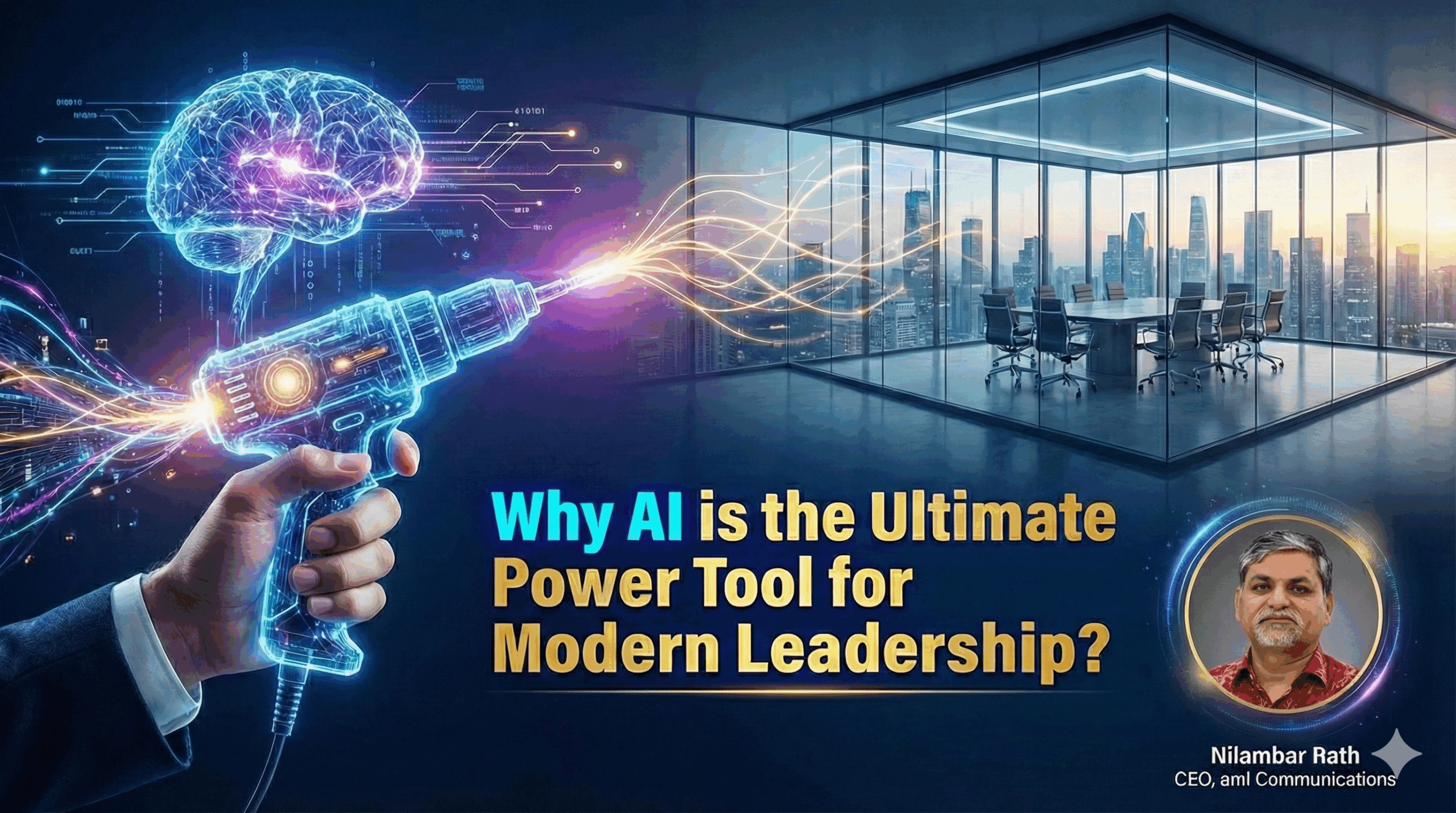
As global business shifts into high gear, senior leaders must move beyond the boardroom hype and personally master AI to navigate a future where technology is the primary driver of strategic success.
Nilambar Rath
The modern C-suite operates in a state of perpetual velocity. Today’s senior executives are bombarded with more data, faster market shifts, and higher stakes than any generation of leaders before them. The traditional toolkit of management—relying on intuition, lagging historical reports, and bloated steering committees—is no longer sufficient to navigate the complexity of the current business landscape. Into this high-pressure environment steps Artificial Intelligence (AI), not merely as another IT utility, but as the most significant boon to executive management since the advent of the internet.
For senior leadership, AI has transitioned from a futuristic concept to an essential collaborative partner. It is transforming the executive function from one of reactive management to proactive, predictive strategy across every facet of the enterprise.
The primary gift AI offers senior leadership is the return of time and the enhancement of vision. In the realms of Business Strategy and Analytics, AI is ending the era of “analysis paralysis.” Instead of waiting weeks for teams to compile quarterly performance reports, executives can now leverage AI-driven “command centers” that synthesize real-time global market data, competitor maneuvers, and internal performance metrics.
AI models can now simulate thousands of strategic scenarios in minutes. A CEO considering a merger or a market pivot can “test-drive” these decisions in a digital twin of the economy, moving strategy from educated guesswork to probabilistic precision. This allows leaders to focus on the why and the what if rather than getting bogged down in the how of data collection.
From R&D to the Front Line: Operations and Innovation
In Product Development and Innovation, AI acts as the ultimate R&D accelerator. It can scan millions of patent databases, scientific journals, and consumer social sentiment to identify “white spaces” for innovation. This drastically reduces the time-to-market, allowing Chief Product Officers to iterate with a speed that was physically impossible five years ago.
The impact on Operations and Customer Service is equally profound. Chief Operating Officers are now using predictive AI to foresee supply chain disruptions before they manifest, optimizing global logistics in real-time. On the customer front, the shift has moved from simple chatbots to sophisticated AI agents that handle 24/7 engagement with high emotional intelligence. This allows the senior leadership to transition customer service from a cost center that handles complaints to a value driver that gathers deep, actionable insights.
Human-Centric Leadership: HR and Communication
In HR and Communication, AI is performing a paradoxical feat: it is using technology to enable greater human connection. Chief People Officers are revolutionizing talent acquisition by using AI to remove unconscious bias from recruitment and to predict retention risks before a high-performer even considers leaving.
For the executive who must communicate with thousands of stakeholders, generative AI helps craft nuanced, personalized messaging at scale. Whether it is a sensitive internal memo or a public-facing strategy shift, AI ensures that the leader’s voice is consistent, empathetic, and culturally tuned to diverse global audiences.
Despite these undeniable advantages, a significant chasm remains. A worrying number of senior executives are still “AI tourists”—they visit the topic in meetings, approve massive budgets for AI implementation, and speak eloquently about the technology at conferences, but they have never personally used the tools.
These are the “armchair generals” of the digital revolution. They delegate AI strategy to the CTO without understanding the visceral potential—or the risks—of the technology. This distance is a liability. An executive who has never personally experimented with a Large Language Model or a predictive analytics tool cannot truly understand how it will “change everything,” as Accenture’s Julie Sweet famously noted. To lead a transformation, one must first be transformed by the tool itself.

The Demographic Threat: The AI-Native Workforce
The urgency for leaders to get their “hands dirty” is fueled by a looming competitive threat: the global young workforce. This new generation of professionals is not just tech-savvy; they are AI-native. They do not view AI as a “new tool” to be cautiously integrated but as a fundamental extension of their own cognitive abilities.
A junior manager armed with sophisticated AI tools can now perform the work of a mid-level team, producing insights and creative outputs that far exceed their years of experience. Tomorrow’s high-performing organizations will be led by those who can bridge the gap between “seasoned experience” and “AI-powered agility.” Leaders who remain distant from the technology will find themselves increasingly outpaced and out-thought by younger counterparts who leverage AI as a force multiplier for every task.
A Universal Boon for Organizations and Governments
The benefits of AI are not limited to the private sector. Governments and non-profits are discovering that AI is a lifeline for managing limited resources. By touching every segment of operations—from public transport optimization to predictive healthcare and streamlined citizen services—the public sector can achieve levels of efficiency that were previously deemed utopian.
For business organizations, the message is clear: AI is the most powerful lever ever created for senior management. It removes the drudgery of data processing, illuminates the path of strategy, and empowers a more human-centric culture.
AI is not a replacement for leadership; it is an augmentation of it. It allows executives to focus on the things only humans can do: ethical judgment, complex negotiation, empathetic mentorship, and creative vision. The “boon” of AI is that it frees the leader to be more human, not less. However, this future belongs only to those leaders who are willing to step out of the “hype” and into the “practice,” putting their own hands on the keyboard to lead their organizations into the next frontier.
About the Author:
Nilambar Rath is a senior communication strategist, development communication specialist, and media educator with over 30 years of experience in India’s journalism and communication landscape. As the Founder and CEO of aml Communications, he specializes in crafting strategic narratives that bridge the gap between complex organizational goals and diverse public stakeholders.
Beyond his corporate leadership, Mr. Rath is a dedicated advocate for public health and social impact communication. As the Co-founder and Co-Chair of the IFI Foundation, he designs and leads large-scale behavioral change campaigns focused on critical healthcare issues.
His expertise lies in leveraging the intersection of technology and human-centric storytelling to drive meaningful dialogue in both the government and non-profit sectors.